
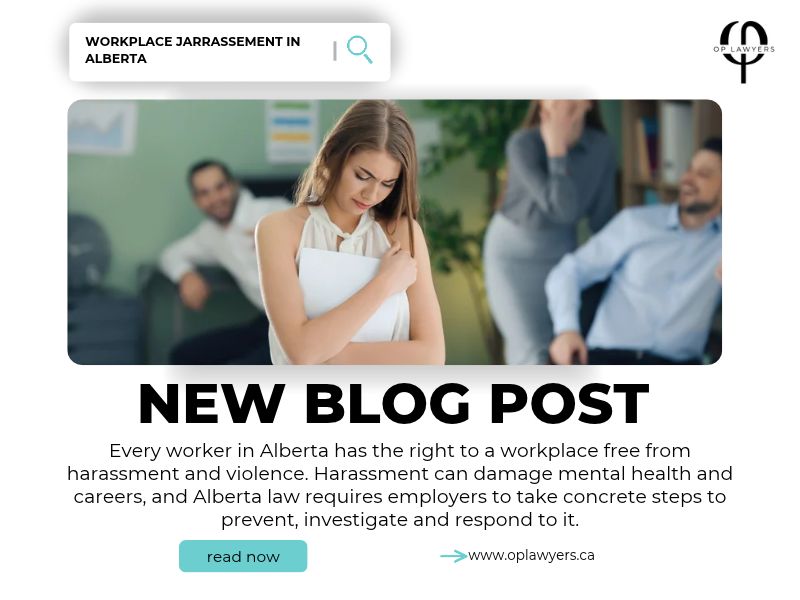
Every worker in Alberta has the right to a workplace free from harassment and violence. Harassment can damage mental health and careers, and Alberta law requires employers to take concrete steps to prevent, investigate and respond to it.
At OP Lawyers LLP, our Calgary employment lawyers advise employees and employers on their rights and obligations under Alberta’s Occupational Health and Safety Act (OHS Act), the OHS Code and the Alberta Human Rights Act. Whether you are experiencing harassment or managing a complaint, understanding the legal framework is the first step.
Key Takeaways
- Harassment under the OHS Act can be a single incident or repeated conduct, and it can be verbal, physical, written or digital.
- Reasonable management actions, such as performance reviews and fair discipline, are not harassment.
- Every Alberta employer must have a written harassment and violence prevention plan and must investigate every complaint.
- Employees who experience harassment may have remedies through an internal complaint, Alberta OHS, the Alberta Human Rights Commission or a constructive dismissal claim.
What Counts as Workplace Harassment?
Under the OHS Act, harassment is any single incident or repeated incidents of objectionable or unwelcome conduct, comment, bullying or action that the person knows, or ought reasonably to know, will cause offence or humiliation to a worker, or that adversely affects the worker’s health and safety. The definition expressly includes sexual solicitation or advances, and conduct connected to protected characteristics such as race, religious beliefs, age, disability, gender, gender identity, gender expression and sexual orientation.
Harassment can be verbal, physical, written or digital. Common examples include yelling, insults, threats, unwanted touching, spreading rumours, deliberate exclusion and offensive jokes. Workplace violence is treated as a separate hazard and includes domestic and sexual violence that spills into the workplace.
Harassment vs. Reasonable Management
The OHS Act excludes reasonable conduct by an employer or supervisor in managing workers or the work site. Performance reviews, discipline, scheduling and fair feedback are not harassment.
Management crosses the line when it becomes abusive, humiliating or targeted. A single critical performance review is not harassment; repeated public belittling, ridicule or punitive workloads aimed at one employee may be. In deciding which side of the line conduct falls on, the key factors are:
- Frequency. Whether the conduct is a one-time event or a pattern.
- Intent and targeting. Whether the conduct is aimed at a particular worker rather than applied fairly to everyone.
- Impact. How the conduct affects the worker’s dignity, health and safety.
Employer Obligations Under Alberta Law
Every Alberta employer must ensure, as far as reasonably practicable, that workers are not subjected to or participating in harassment or violence. Part 27 of the OHS Code requires a written harassment and violence prevention plan that sets out:
- Measures to eliminate harassment and violence hazards or, where that is not reasonably practicable, to control them
- How workers will be informed of threats
- How workers can report incidents
- How complaints and incidents will be investigated
- How confidentiality will be protected, subject to limited exceptions
Employers must also:
- Assess the hazard. Address harassment and violence in their hazard assessments.
- Involve workers. Involve the joint health and safety committee, health and safety representative or affected workers in developing and reviewing the plan.
- Train. Train workers to recognize, respond to and report harassment and violence.
- Review regularly. Review the plan at least every three years, and sooner after an incident or a change in the workplace.
The Investigation Process
Every complaint and incident must be investigated, and the employer must prepare a written report describing the circumstances and any corrective action taken. Reports must be kept for at least two years and provided to Alberta OHS on request.
A fair investigation should be prompt, impartial and thorough. It usually involves:
- Interviewing the complainant, the respondent and witnesses
- Reviewing emails, texts and other messages
- Deciding whether harassment occurred
- Telling both parties the outcome and following through with corrective action
Where neutrality or expertise is lacking internally, an external investigator is often the safest option.
Employers must also offer support to affected workers, advise them that they may consult a health professional of their choice, and treat time spent with a physician during regular working hours for incident-related treatment as time worked. An inadequate investigation can expose an employer to OHS orders, human rights complaints and constructive dismissal claims.
Employee Rights and Remedies
Alberta employees have several avenues if they experience harassment:
- Internal complaint. Report through the employer’s prevention plan and keep a copy of your complaint.
- OHS complaint. If the employer fails to meet its obligations, a worker can contact Alberta OHS. The OHS Act prohibits reprisals against workers who raise concerns or participate in investigations.
- Human rights complaint. If the harassment relates to a protected ground, a complaint may be filed with the Alberta Human Rights Commission, generally within one year of the incident. Remedies can include lost wages and damages for injury to dignity.
- Constructive dismissal. Where harassment is so serious, or the employer’s response so inadequate, that the workplace becomes intolerable, a court may treat a resignation as a termination without cause, entitling the employee to damages for reasonable notice.
Speak with a Calgary employment lawyer before resigning, as quitting without advice can weaken a constructive dismissal claim.
Harassment by Co-Workers, Clients and Contractors
Harassment is not limited to supervisors. Employers must address harassment by co-workers, clients, customers and contractors, as well as conduct at off-site meetings, business travel and work social events.
Remote and Digital Workplaces
Harassment by email, text, messaging platforms, video calls or social media is covered where it affects the workplace or the employment relationship. Prevention plans should expressly address remote communications, and employees should save screenshots and messages and report them through formal channels.
Practical Tips
For employees:
- Document everything. Keep notes of dates, times, witnesses and what was said or done, and save messages and screenshots.
- Use the formal process. Report through your employer’s prevention plan and keep a copy.
- Watch the deadlines. Human rights complaints generally must be filed within one year.
- Do not resign without advice. Speak with a lawyer first to protect a possible constructive dismissal claim.
For employers:
- Keep your plan current. Make sure your prevention plan is up to date and accessible to every worker.
- Train regularly. Train managers and staff on recognizing and reporting harassment.
- Respond promptly. Encourage early reporting and investigate every complaint quickly and fairly.
- Lead by example. Model respectful conduct and hold everyone accountable.
How OP Lawyers LLP Can Help
Workplace harassment affects health, careers and the bottom line. Whether you are an employee who needs to know your options or an employer who needs a compliant plan, early legal advice can prevent a difficult situation from becoming a costly one.
At OP Lawyers LLP, our Calgary employment lawyers can help you:
- Assess your situation in a confidential consultation and explain your options
- Prepare an internal complaint, OHS complaint or human rights complaint
- Advise on constructive dismissal and negotiate a severance package
- Draft and update harassment and violence prevention plans
- Train managers and conduct or oversee workplace investigations
- Defend harassment, human rights and constructive dismissal claims
If you are facing workplace harassment or need a compliant prevention plan, contact OP Lawyers LLP to book a consultation with an experienced Calgary employment lawyer.
Frequently Asked Questions
Can a single incident be harassment in Alberta?
Yes. Under the OHS Act, harassment can be a single incident or repeated incidents of objectionable or unwelcome conduct, as long as the person knew or ought reasonably to have known it would cause offence or humiliation or harm the worker’s health and safety.
Is my manager harassing me by criticizing my work?
Not necessarily. Reasonable management actions such as performance reviews, discipline and fair feedback are not harassment. Conduct may cross the line when it becomes abusive, humiliating or targeted.
Does my employer have to investigate my complaint?
Yes. Alberta employers must investigate every harassment complaint and incident and prepare a written report describing the circumstances and any corrective action taken.
Can I be punished for reporting harassment?
No. The OHS Act prohibits reprisals against workers who raise health and safety concerns, including harassment, or who participate in an investigation.
Should I quit if the harassment does not stop?
Speak with a Calgary employment lawyer first. In serious cases, a resignation may be treated as constructive dismissal, but quitting without advice can weaken your claim.
Disclaimer: This blog post is intended for informational purposes only and does not constitute legal advice. For advice specific to your circumstances, please consult a qualified Calgary employment lawyer at OP Lawyers LLP or another legal professional.