
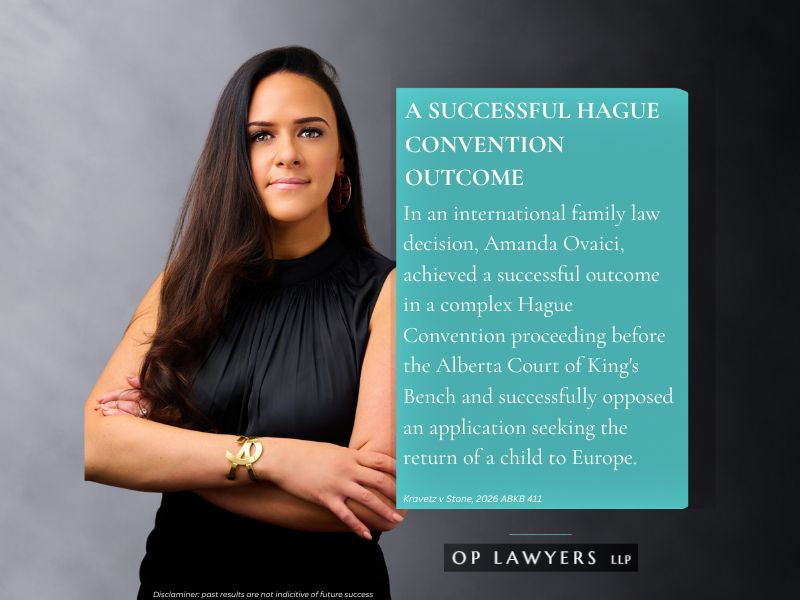
In an international family law decision, our Calgary family lawyer, Amanda Ovaici, achieved a successful outcome in a complex Hague Convention proceeding before the Alberta Court of King's Bench. Acting for the Respondent mother, Amanda successfully opposed an application seeking the return of a child to Europe under the Convention on the Civil Aspects of International Child Abduction (the Hague Convention). The decision was ultimately rendered by Justice G.A. Campbell in Kravetz v Stone, 2026 ABKB 411.
Hague Convention cases are among the most challenging matters in family law. Unlike traditional parenting disputes, these applications involve international law, urgent timelines and a specific legal test. Courts are generally required to order the return of a child to their country of habitual residence when a wrongful removal or retention has occurred. Because of this, successfully resisting a Hague Convention return application is often challenging
This case demonstrates both the complexity of international child abduction proceedings and the narrow circumstances in which a court may decline to order a child's return.
The Father's Application
The application arose after the parties' child had been removed from Europe and relocated to Alberta. The father brought an application under the Hague Convention seeking the child's return. He argued that Italy was the child's habitual residence and that the child's removal breached his custodial rights. He further argued that none of the recognized Hague Convention exceptions applied.
The mother opposed the application and raised several arguments. Among other things, she argued that returning the child would expose the child to serious risks and place the child in an intolerable situation. The mother also raised concerns relating to family violence, the child's circumstances, and the concerning realities surrounding a potential return to Italy.
The Importance of Article 13(b)
The Hague Convention contains limited exceptions to the general obligation to return a child to their country of habitual residence. One of the most important exceptions is found in Article 13(b).
Article 13(b) permits a court to refuse a return order where there is a grave risk that returning the child would expose them to physical or psychological harm or otherwise place them in an intolerable situation. Courts across Canada have repeatedly emphasized that this exception is narrow and must be applied cautiously in order to preserve the Hague Convention's overall objective of deterring international child abduction.
Despite that high threshold, Amanda successfully argued that this was one of those exceptional cases.
The Court's Findings
Justice Campbell undertook a lengthy review of the evidence and examined the circumstances surrounding the parties' relationship, allegations of domestic violence, parenting arrangements, living conditions, and the practical realities that the child would face upon a return to Italy.
Importantly, the Court made several credibility findings during the proceedings. Justice Campbell found that the father had deliberately altered documentary evidence that had been filed before the Court. The Court described the conduct as serious, found that the father had attempted to mislead the Court, and concluded that the father's actions significantly damaged his credibility. As a result, the Court indicated it had no confidence in the reliability of much of the father's documentary evidence unless independently corroborated.
While the Court emphasized that family violence alone does not automatically trigger the Article 13(b) exception, it carefully reviewed the evidence and the broader circumstances affecting the child. The Court considered numerous authorities addressing when domestic violence and instability may create an intolerable situation sufficient to justify refusing a return order. While further concerns arose as to whether either parent still resided in Italy.
Ultimately, Justice Campbell concluded that the evidence established a grave risk that returning the child to Italy would place the child in an intolerable situation. The Court was particularly concerned about the uncertainty surrounding the child's living arrangements, the practical realities of a return, and whether any proposed undertakings would adequately protect the child. The Court expressly found that the risks identified could not be sufficiently mitigated through undertakings or protective measures.
Why the Decision Matters
This decision is noteworthy.
The Hague Convention was designed to prevent parents from obtaining strategic advantages by removing children across international borders. As a result, courts generally begin from the presumption that children should be returned promptly to their habitual residence so that parenting disputes can be determined there.
Justice Campbell acknowledged this principle directly, emphasizing that international child abduction is a serious issue and that return remains the general rule under the Convention. Nevertheless, the Court recognized that the Convention itself contemplates exceptional cases where a return would create unacceptable risks for a child.
The decision illustrates that while the Hague Convention strongly favours return, Canadian courts remain prepared to intervene when compelling evidence demonstrates that a return would expose a child to grave risk or place them in an intolerable situation.
The Result
After completing the Hague Convention analysis, Justice Campbell concluded that although the father had established habitual residence in Italy and demonstrated the existence of custodial rights, the mother had successfully proven the Article 13(b) exception.
The Court held that returning the child to Italy would expose the child to a grave risk of being placed in an intolerable situation. Because the exception had been established, the Court was not required to order the child's return. The father's Hague Convention application was therefore dismissed in its entirety.
Justice Campbell specifically stated:
"The Mother has established, on a balance of probabilities, that this is one of those limited cases."
The Court further concluded that the father's application should be dismissed and noted that the mother, as the successful party, is entitled to costs.
A Significant Family Law Success
Amanda Ovaici appeared as counsel for the Respondent mother throughout the proceedings. The case involved extensive affidavit evidence, expert evidence from a psychologist regarding the child's views, oral testimony from multiple witnesses, credibility disputes, international custody issues, and the application of complex Hague Convention principles.
Successfully defending a Hague Convention application requires navigating not only Alberta family law but also international obligations, evidentiary challenges, and highly specialized jurisprudence. In this matter, despite findings that initially favoured the applicant on key threshold issues, Amanda successfully established that the circumstances met the narrow Article 13(b) exception.
The result was a complete dismissal of the return application and a finding that the child would not be returned to Italy under the Hague Convention.
This decision stands as a notable example of a highly specialized area of international family law and highlights the Alberta Court's willingness to apply the protective exceptions contained within the Hague Convention when the evidence demonstrates that a child's return would create an intolerable situation.
Click here for the full case: Kravetz v Stone, 2026 ABKB 411