
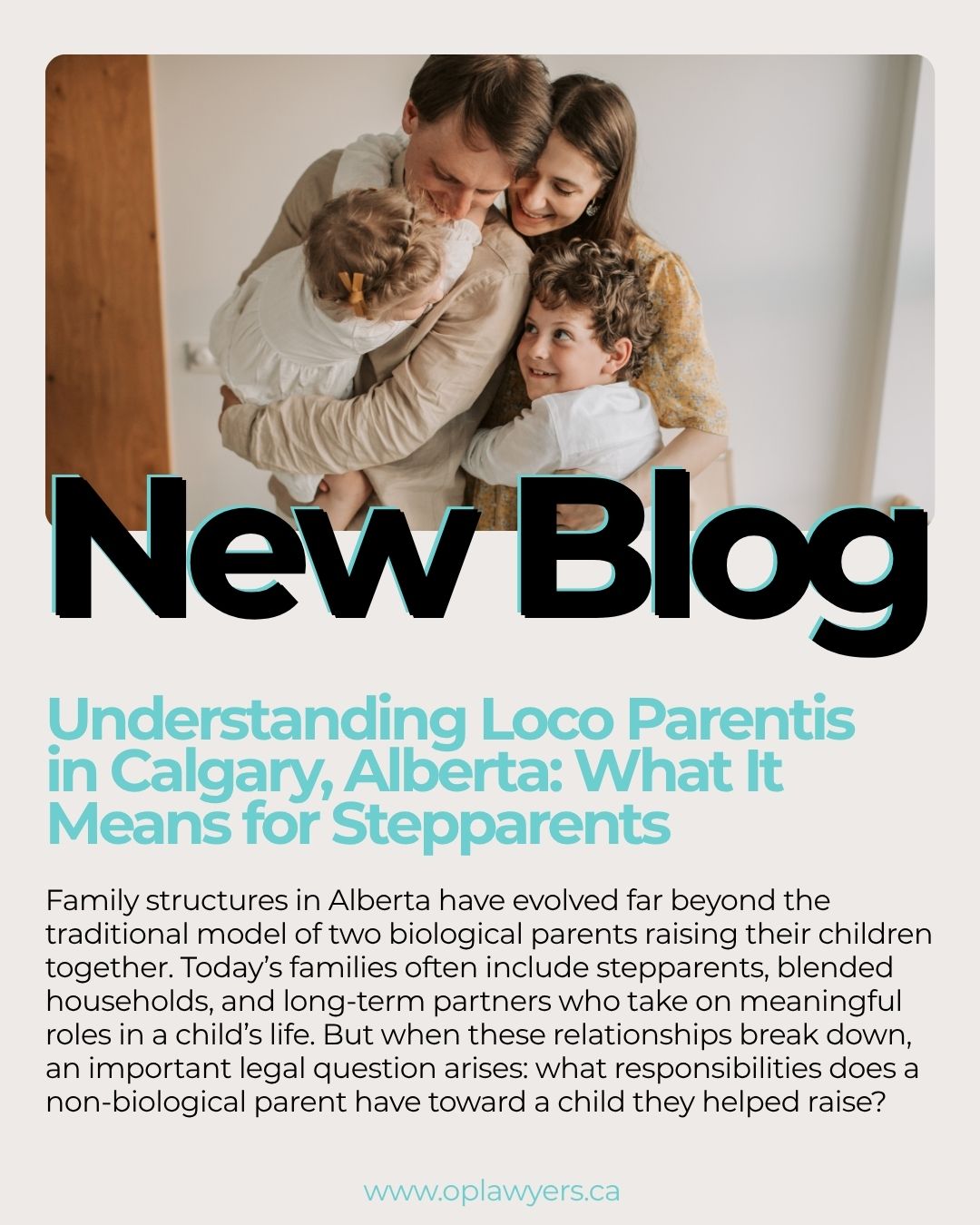
Family structures in Alberta have evolved far beyond the traditional model of two biological parents raising their children together. Today’s families often include stepparents, blended households, and long-term partners who take on meaningful roles in a child’s life. But when these relationships break down, an important legal question arises: what responsibilities does a non-biological parent have toward a child they helped raise?
This is where the legal concept of in loco parentis becomes crucial. At OP Lawyers LLP, our Calgary Family Lawyers can provide guidance on this complex area of the law.
What Does In Loco Parentis Mean?
In AIn loco parentis is a Latin term meaning “in the place of a parent.” In Alberta family law, it refers to a situation where an individual has taken on the role of a parent in a child’s life, emotionally, financially, and practically, despite not being biologically related.
When someone is found to stand in loco parentis, they may be treated as a parent in the eyes of the law. This includes both rights (such as decision-making and parenting time) and responsibilities (including child support).
The leading case on this issue in Canada is Chartier v Chartier [1999] 1 S.C.R. 242, where the Supreme Court of Canada confirmed that a person who has acted as a parent cannot simply walk away from that role after a relationship ends.
The Legal Framework in Alberta
The In Alberta, the concept of in loco parentis is governed by both provincial and federal legislation, including:
- Family Law Act
- Divorce Act
Under these laws, the court must first determine whether the individual:
- Was married to, or in an adult interdependent relationship with, the child’s parent; and
- Demonstrated a settled intention to treat the child as their own
If both elements are met, the court will then conduct a detailed, fact-based analysis.
What Factors Do Courts Consider?
Determining whether someone stands in loco parentis is not always straightforward. Courts look at the totality of the relationship, including factors developed in Chartier v Chartier and Alberta case law.
Key considerations may include:
- The child’s age at the time the relationship began
- Length and stability of the relationship
- Whether the person provided financial support
- The extent of involvement in daily care, discipline, and education
- Whether the person represented themselves as a parent to the child and others
- The child’s perception of the person (did they see them as a parent?)
- The nature of the relationship with the biological parents
- Whether adoption or guardianship was ever discussed or pursued
- Whether the person maintained contact after separation
No single factor is decisive. Courts weigh all evidence to determine whether a genuine parental relationship existed. Other factors may also apply.
Financial Obligations: Child Support
One of the most significant consequences of being found in loco parentis is the obligation to pay child support.
If a step-parent is deemed to have acted as a parent:
- They may be required to pay support as if they were a biological parent
- Support is calculated using the Federal Child Support Guidelines
However, Alberta courts recognize that step-parent obligations are often secondary to those of biological parents. This means the court may consider:
- What is fair and appropriate in the circumstances
- The financial means of all parties
- The involvement of biological parents
Rights and Responsibilities Beyond Support
Being in loco parentis is not just about financial obligations, it also involves parental authority and responsibility.
A person found to stand in this role may have:
- Decision-making authority regarding the child’s education, healthcare, and upbringing
- The ability to apply for parenting time
- A say in important aspects of the child’s daily life
In some cases, individuals may choose to limit or waive decision-making responsibilities through a court order. However, financial obligations, especially child support generally remain enforceable.
Can Someone Stop Being In Loco Parentis?
In more serious situations, grandparents may apply for guardianship (custody). This is a significant legal step that transfers parenting authority anA common misconception is that a step-parent can simply withdraw from a child’s life and avoid legal responsibility. The court’s focus is always on the best interests of the child, not the preferences of the adult
Why These Cases Can Be Complex
Each in loco parentis case is highly fact specific. Two similar situations may lead to different outcomes depending on:
- The depth of the relationship
- The intentions of the parties
- The child’s emotional reliance on the individual
Because of this complexity, courts take a careful and nuanced approach, balancing fairness to the adult with the need to protect the child’s well-being and stability. Seeking legal advice from a Calgary Family Lawyer may help reduce uncertainty and provide clarify with respect to your fact specific matter.
Final Thoughts
As family structures continue to evolve, the law in Alberta has adapted to reflect the realities of modern parenting. The concept of in loco parentis ensures that children are not left without support simply because a parental figure is not biologically related to them.
For stepparents and partners, the key takeaway is this:
If you take on the role of a parent, the law may hold you to it even after the relationship ends.
Understanding your rights and obligations early can help you make informed decisions about your role in a child’s life.
Contact OP Lawyers LLP
If you are unsure whether you may be considered in loco parentis, or if you are facing a child support or parenting dispute, our Calgary Family Lawyers at OP Lawyers LLP can help. We provide clear, practical advice tailored to your situation so you can move forward with confidence.
Disclaimer: This blog post is intended for informational purposes only and does not constitute legal advice. For advice specific to your circumstances, please consult a qualified lawyer at OP Lawyers LLP or another legal professional.