
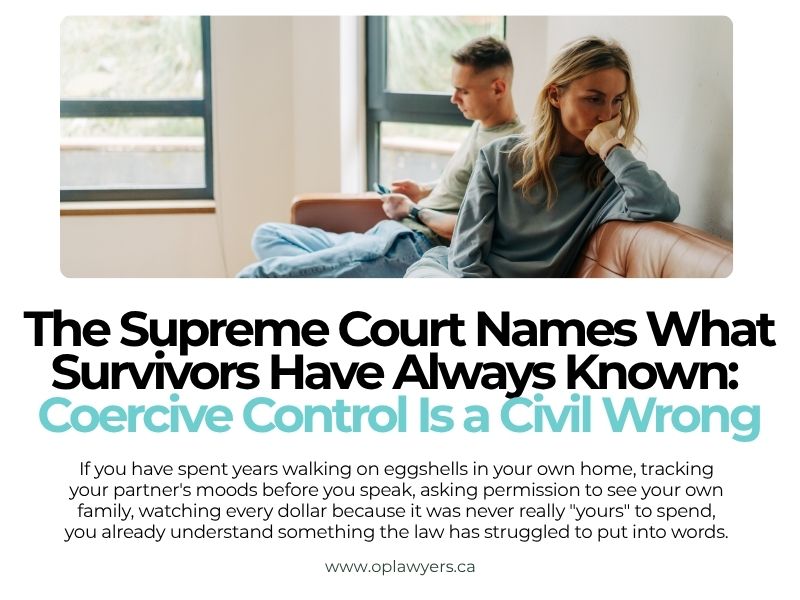
If you have spent years walking on eggshells in your own home, tracking your partner's moods before you speak, asking permission to see your own family, watching every dollar because it was never really "yours" to spend, you already understand something the law has struggled to put into words. You know that abuse is not always a bruise. It is often a slow, deliberate narrowing of your world until you can no longer tell where your choices end and your partner's control begins.
On May 15, 2026, the Supreme Court of Canada gave that experience a name in law: coercive control. In Ahluwalia v. Ahluwalia, 2026 SCC 16, the Court recognized a brand-new civil wrong; the tort of intimate partner violence, built specifically around this pattern of domination, rather than around isolated incidents of hitting, shoving, or shouting. Before we go further, if you recognize yourself in that description, we want to say plainly: what happened to you was not a private family matter you were supposed to just manage. It was a legal wrong with a legal remedy.
At OP Lawyers LLP, our Calgary Civil Lawyers can give you guidance to better understand your rights as it related to the tort of intimate partner violence.
Coercive control, as the Court described it, is conduct that limits a partner's ability to make their own choices and that undermines their dignity, autonomy, and equality within the relationship. It is not limited to physical violence. It can include isolation from friends and family, humiliation, surveillance, financial control, sexual coercion, and intimidation. The everyday tools an abuser uses to keep a partner smaller, more dependent, and more afraid than they would otherwise be.
An Important Note Before We Go Further: This Is a Civil Matter, Not a Family Law Matter
Because Ahluwalia arose out of a divorce, it is easy to assume this is simply a "family law" case. It is not. The tort of intimate partner violence is a civil cause of action, a claim for monetary damages, governed by the ordinary rules of civil litigation. Ms. Ahluwalia's claim for damages proceeded alongside her family law claims for support, property, and parenting, but it was legally determined as a separate civil claim grafted onto the family proceedings.
This distinction matters enormously for anyone thinking about pursuing (or defending) a claim like this. Commencing or defending an intimate partner violence claim calls for civil litigation experience. A Calgary Civil Lawyer can assist you with this. Not all firms combine family law knowledge with civil litigation under one roof. The OP Lawyers LLP team has lawyers that are experienced and practice in both Civil Litigation and Family Law in Alberta.
How the Case Got to the Supreme Court
Kuldeep Ahluwalia and Amrit Ahluwalia married in India in 1999 and moved to Canada in 2001. Over sixteen years of marriage, Ms. Ahluwalia experienced physical assaults alongside a broader pattern of controlling behaviour; restrictions on her ability to work, pursue an education, or maintain relationships with her own family, tight control over the family's finances, and even being prevented from visiting her dying mother. When the couple separated in 2016, Mr. Ahluwalia commenced divorce proceedings, and Ms. Ahluwalia, representing herself for part of the litigation, sought damages for the abuse alongside her family law claims.
In 2022, the trial judge found that the existing torts; assault, battery, and intentional infliction of emotional distress, could not fully capture the cumulative harm of a long-term pattern of coercion and control, and recognized a new tort of "family violence," awarding $150,000 in damages. The Ontario Court of Appeal disagreed in 2023, holding that existing torts were adequate and reducing the award to $100,000. Ms. Ahluwalia then appealed to the Supreme Court, not to challenge the dollar figure, but on the question of principle: should Canadian law recognize a distinct tort for this kind of harm at all?
The Legal Test
Writing for the majority for the Supreme Court, Justice Kasirer held that the existing law was incomplete. As the Court explained, intimate partner violence "is more than the sum of its parts"; the totality of coercive conduct within an intimate partnership takes on a different meaning and produces a different kind of harm than the same acts would between strangers (para. 140). Existing torts like assault or intentional infliction of emotional distress can capture discrete acts, or even patterns of them, but they were never built to redress the distinct dignitary harm of losing one's autonomy and being rendered unequal within a relationship (paras. 142–143).
To make out the new tort, the majority set out a three-part legal test, explained at paragraph 182 of the reasons. A plaintiff must establish:
- Relational context — the abusive conduct arose within an intimate partnership, or in its aftermath following separation (para. 182).
- Intent — the defendant intentionally engaged in the abusive conduct. The plaintiff does not need to show the defendant intended to control or dominate them specifically — only that the conduct itself was intentional (para. 182).
- Coercive control, assessed objectively — the conduct, viewed as a whole and from an objective standpoint, amounted to coercive control that deprived the plaintiff of dignity, autonomy, or equality within the relationship (paras. 140, 182).
Importantly, once those three elements are proven, the plaintiff does not need to separately prove a specific psychological or medical injury, the harm to dignity, autonomy, and equality is treated as inherent in coercive control itself (para. 182).
What Conduct Can Count as Coercive Control?
The Court was clear that coercive control is not limited to physical violence. Conduct the Court identified as capable of forming part of a coercive control pattern includes:
- Physical abuse — hitting, shoving, or otherwise using physical force, along with the threat of it
- Psychological and verbal abuse — put-downs, name-calling, and a steady drip of criticism meant to erode self-worth
- Economic abuse — controlling household income, blocking access to bank accounts, or interfering with a partner's ability to work
- Social isolation — driving a wedge between a partner and their support network of family, friends, or community
- Monitoring and control of daily life — checking a partner's phone, location, or whereabouts without their consent
- Sexual violence or coercion — forcing or pressuring a partner into sexual activity against their will
- Threats aimed at what a partner loves most — including threats involving children, pets, or self-harm, used to instill fear
- Weaponizing the legal system after separation — dragging out or misusing court proceedings to keep exerting control over a former partner
No single item on this list, taken alone, necessarily proves the tort. The Court's focus is on the cumulative, patterned effect of this conduct and whether taken together and viewed objectively, it renders one partner subordinate to the other and strips them of their dignity, autonomy, and equality within the relationship. It is important to understand your rights by speak with a Calgary Lawyer for claims related to tort of intimate partner violence.
The Court was also careful to underline that this is not a tort for garden-variety relationship conflict, poor communication, or the ordinary bitterness of a difficult separation. It requires a genuine, objectively assessed pattern of domination. And crucially for anyone navigating a separation, the Court recognized that abuse frequently continues after a couple splits up including through co-parenting dynamics that force ongoing contact between former partners (para. 185). Specifically named "litigation abuse," where a former partner weaponizes the court process itself to continue exerting control, as a well-documented post-separation tactic (para. 194).
Three justices; Jamal, Côté, and Rowe dissented, taking the view that existing torts already fully compensated Ms. Ahluwalia and that recognizing an entirely new tort was unnecessary and risked introducing uncertainty into the law. Justice Karakatsanis, meanwhile, concurred in recognizing the new tort but would have gone further than the majority on one of its elements. The debate itself is instructive: even judges who disagreed on the need for a new tort did not dispute that the harm coercive control causes is real and serious.
Why This Matters
For survivors, this decision does more than create a new line item on a damages award. It validates an experience that has too often been minimized precisely because it doesn't leave a visible mark; the slow erosion of independence, confidence, and safety that can be just as devastating as a single violent incident, and sometimes more dangerous, since patterns of control are a recognized predictor of escalating risk.
If this decision resonates with your own experience, the most important next step is a conversation with a Calgary lawyer who can assess both the family law and civil law dimensions of your situation, so nothing about your claim is left unaddressed simply because it fell between two areas of practice.
This article is intended to provide general legal information and does not constitute legal advice. If you are experiencing intimate partner violence, support is available. Please reach one of our Calgary Civil Lawyers to discuss your circumstances.